Lexington Metal Roof Coating Questions
Straight answers on rust, fasteners, laps, coating choices, weather, permits, and cost for commercial metal roofs in Lexington, Paris, and Hamburg.
Lexington Metal Roof Coating Questions By Topic
Metal roof coating is a liquid-applied membrane that bonds to steel roof panels and cures into one flexible, waterproof skin. Lexington Metal Roof Coating coats commercial metal roofs and installs silicone, acrylic, spray foam, and shingle roof coatings on business, industrial, and farm buildings in Lexington, Fayette County, Kentucky, and nearby areas including Paris and Hamburg.
Metal Roof Coating Basics
What Does a Metal Roof Coating Actually Do?
Metal roof coating is a fluid-applied membrane that bonds to steel panels and cures into a continuous rubbery skin over the panels, laps, and fastener heads. It goes on with spray rigs, rollers, and brushes after the roof is cleaned and rust is treated.
On a warehouse or shop roof, the coating does three jobs:
- Seals the panel laps, end laps, and fastener washers where most metal roof leaks start.
- Shields bare or rusting steel from more water and oxygen.
- Reflects sunlight when a white or light color is used, which lowers the panel surface temperature.
The steel still carries the structural load. The coating protects its outer face.
Which Metal Roofs Are Good Candidates for Coating?
Roofs with solid panels, firm attachment to the purlins, and surface rust only are the best candidates for a metal roof coating. A crew walks the roof and checks for soft spots, rust-through holes, and panels that flex between purlins.
Common candidates around Lexington include:
- Exposed-fastener R-panel on warehouses, shops, and self-storage buildings.
- Corrugated steel on barns, arenas, and equipment sheds.
- Standing seam roofs on offices and retail buildings with leaking seams or worn paint.
Panels rusted through in wide areas, crushed by hail, or pulled loose from the framing need replacement sheets first. A handful of bad sheets can be swapped and the whole roof coated afterward.
Should I Coat, Restore, Re-Panel, or Replace My Metal Roof?
Rust depth and panel strength decide whether a metal roof gets a coating, a full restoration, new panels in spots, or a complete replacement.
| Option | What it involves | Fits when |
|---|---|---|
| Coat | Clean, prime rusty spots, seal laps and fasteners, apply topcoat | Paint is worn, rust is light, a few fasteners leak |
| Restore | Coat steps plus fastener replacement, seam fabric, and skylight panel swaps | Many backed-out screws, leaking end laps, cracked skylights |
| Re-panel | Remove and replace damaged sheets, then coat the roof | Isolated rust-through or crushed panels |
| Replace | Tear off panels and install a new roof system | Widespread rust-through, weak purlins, or failed framing |
Most roofs land in the coat or restore rows. Close-up photos of the eave panels and the gutter line usually tell the story, since water crosses those areas on every rain.
Can a Coating Stop Leaks at Fasteners and Panel Laps?
Yes, a coating stops leaks at fasteners and panel laps when those spots are repaired before the topcoat goes on. Paint alone over a loose screw or an open lap will split as the panels move.
The usual sequence:
- Tighten or replace fasteners with worn or cracked washers.
- Seal each fastener head with a dab of sealant or a coating cap.
- Embed reinforcing fabric or seam tape over side laps and end laps.
- Apply the base and top coats over the full roof.
Leaks around rooftop curbs, pipe boots, and ridge caps get the same treatment, since a coated field with an open flashing still lets water in.
Rust, Fasteners and Seams
What Is the Difference Between Red Rust and White Rust on a Metal Roof?
Red rust means the steel underneath is corroding, and white rust means the galvanized zinc layer on top is the part breaking down. White rust looks like a chalky white powder and forms where water sits, such as end laps and low panel ribs.
Red rust shows as orange or brown staining, scale, and blisters, usually around fastener heads and at the eaves.
Both need attention before coating:
- White rust is cleaned off so the primer bonds to firm metal.
- Red rust is wire-brushed or ground back to tight rust, then sealed with a rust-inhibiting primer.
Red rust that flakes away when scraped means the panel is close to rusting through, so check that spot from inside the building too.
Why Do Metal Roof Fasteners Back Out and Leak?
Fasteners back out because steel panels expand in summer heat and shrink in cold weather, and that movement works the screws loose over the years. The rubber washers under the screw heads also harden and crack in sunlight.
Signs to look for on the roof:
- Screw heads standing above the panel surface.
- Cracked or missing washers.
- Rust rings or streaks around fastener heads.
- Water stains on insulation under fastener rows.
Crews replace loose screws with oversized fasteners that bite fresh metal, add new washers, and seal each head before coating. A large R-panel roof can hold thousands of screws, so fastener work takes a big share of the labor.
How Are Panel Laps and End Laps Sealed Before Coating?
Panel laps and end laps are sealed with reinforcing fabric or butyl-backed seam tape set into a base coat, then covered by the full coating. Side laps run up the slope where two panels overlap. End laps run across the slope where an upper panel overlaps a lower one.
End laps cause more trouble on low-pitch metal roofs because water backs up under the upper panel. Crews clean these joints, treat rust inside them, and apply a wider band of reinforcement there.
The sealed lap shows as a slightly raised strip under the finished topcoat, which makes later inspections easier.
What Prep Differs Between Standing Seam and Exposed-Fastener Roofs?
Standing seam roofs need most of their prep at the seams, clips, and trim, while exposed-fastener roofs need it at every screw and lap.
| Prep item | Standing seam | Exposed-fastener (R-panel) |
|---|---|---|
| Fasteners | Hidden clips, few exposed screws at trim | Thousands of exposed screws to tighten, replace, and seal |
| Seams | Raised seams checked for open or unlatched runs | Side laps and end laps reinforced with fabric or tape |
| Rust spots | Panel field and cut edges at eaves | Fastener heads, laps, and eaves |
| Trim and flashing | Ridge caps, rake trim, and pipe boots | Ridge caps, eave closures, and gutters |
| Coating focus | Seams and penetrations | Fasteners, laps, and full field |
Standing seam panels slide on their clips as temperatures change, so the coating at the seams has to stay flexible. When a standing seam roof still carries a factory finish or panel maker's terms, that maker's guidance comes first.
How Are Skylight Panels and Ridge Caps Handled During Coating?
Skylight panels and ridge caps are repaired or replaced first, then tied into the coating so the roof drains as one surface. Fiberglass skylight panels on metal buildings yellow, crack, and leak at their laps over time.
For skylights, owners choose between:
- Replacing worn panels with new translucent sheets.
- Coating over old panels, which closes them off to daylight.
- Adding screens over panels that stay, since brittle skylights are a fall hazard during roof work.
Ridge caps get fresh closures, sealed fasteners, and reinforced laps, because wind-driven rain often enters at the ridge. Crews mask every skylight that stays in service so overspray never dulls it.
Do Gutters and Eave Trim Get Coated Too?
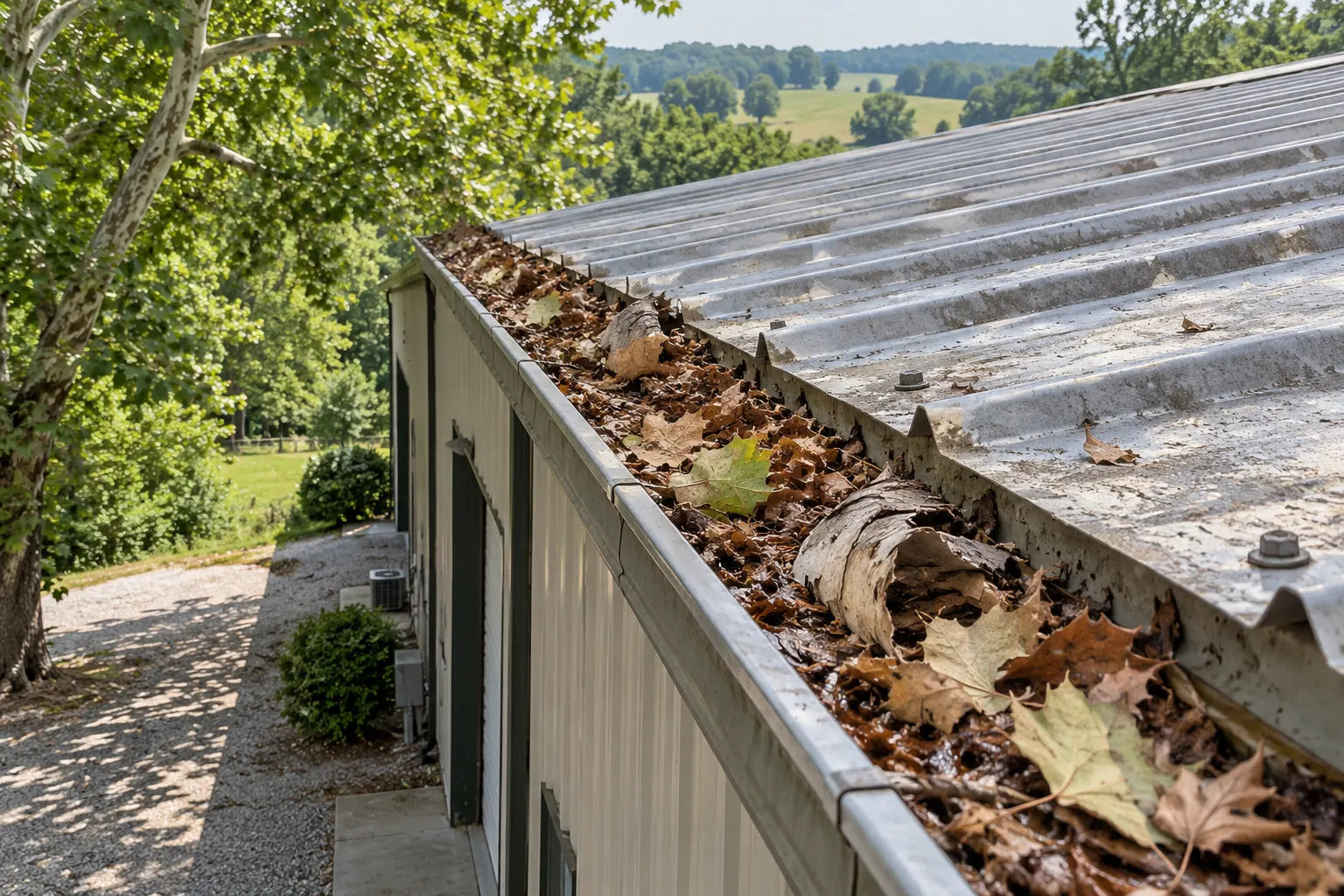
Gutters and eave trim can be coated along with the roof, and gutter interiors are one of the first places rust starts. Leaves, grit, and standing water in a box gutter hold moisture against the steel for weeks.
Before coating, crews:
- Clear debris and flush the downspouts.
- Wire-brush rust and seal joints at gutter seams and end caps.
- Check that hangers hold the gutter at a steady pitch.
Rusted-through gutter sections and crushed downspouts are replaced instead of coated. Water from the whole roof passes over the eave, so the last few feet of panel above the gutter get extra attention for rust and open end laps.
Choosing a Coating
Should I Use Silicone, Acrylic, or Urethane on a Metal Roof?
Silicone, acrylic, and urethane all work over metal, and the choice rests on drainage, foot traffic, and weather during application.
| Coating | Strong points over metal | Limits | Fits best on |
|---|---|---|---|
| Silicone | Holds up under ponding water and sun | Collects dirt; later coats mostly have to be silicone | Low-pitch roofs that hold water at end laps or gutters |
| Acrylic | Water-based, bright white, low odor | Breaks down where water stands; needs warm, dry days to cure | Steeper metal roofs that shed water fast |
| Urethane | Tough under foot traffic and impact | Solvent odor; often used as a base or for traffic zones | Walk paths to rooftop units and service areas |
Many metal roofs pair a rust-inhibiting primer with one of these topcoats. A small adhesion test on the actual panels confirms the bond before the full roof is coated.
When Is Silicone the Better Coating for a Metal Roof?
Low-pitch metal roofs where water sits at end laps after rain are where silicone beats the other coatings, because it resists breakdown under standing water.
Points to weigh:
- Recoating later generally calls for silicone again, since most other coatings bond poorly to it.
- Dirt pickup dulls the white surface faster, which lowers reflectance over time.
- Slick footing when wet makes granule walk paths a good idea near rooftop units.
On metal, silicone goes over a primer matched to the panel type, with extra material built up at fasteners, laps, and around curbs.
When Does Acrylic Make Sense on a Metal Roof?
Acrylic makes sense on well-sloped metal roofs that shed water quickly, like steeper barn and shop roofs. It is water-based, so it has low odor and cleans up with water, which helps on buildings that stay occupied.
It needs dry weather to cure. Central Kentucky dew and pop-up showers can wash fresh acrylic off panels, so crews watch the forecast closely in spring and fall.
Acrylic stays bright white and reflects sun well from the panel surface. On roofs with ponding at end laps, valleys, or behind rooftop units, it wears out faster, and silicone becomes the stronger pick for those areas.
Is Spray Foam Over Metal Better Than a Coating Alone?
Spray foam over metal adds insulation and one continuous layer over every lap and fastener, while a coating alone seals and protects the panels with far less thickness.
| Factor | Coating only | Spray foam plus coating |
|---|---|---|
| Insulation | Very little | Closed-cell foam adds about R-6 per inch |
| Panel profile | Ribs stay visible | Foam fills between ribs and levels the surface |
| Condensation under panels | Little change | Warmer panel underside cuts dripping |
| Roof edge | Stays the same height | Rises, so gutters and eave trim need new details |
| Upkeep | Recoat when worn | Recoat the topcoat and repair foam damage |
The R-6 figure comes from a U.S. Department of Energy Building America spray foam guide. Foam suits heated shops and barns that drip condensation. A coating alone fits roofs where the insulation under the panels is already in good shape.
Can Asphalt Shingle Roofs on Commercial Buildings Be Coated?
Asphalt shingle roofs on commercial buildings can be coated in some cases, though shingle condition and the shingle maker's approval set firm limits. Shingled strip centers, office buildings, and churches with sloped roofs make up most of this work.
Coating fits only when:
- Shingles lie flat, with tabs still bonded.
- Granule loss is light, with no bare asphalt showing.
- Flashing at walls, chimneys, and valleys is intact.
- The manufacturer's terms allow a coating.
Curled, cupped, or missing shingles need replacement first. A coating also changes how a shingle roof looks, so check with the shingle maker and, in a historic district, the review staff before choosing it.
Climate and Weather in the Bluegrass
How Does Lexington's Rainfall Affect a Coated Metal Roof?
Lexington gets close to 50 inches of precipitation in an average year, so drainage at end laps, valleys, and gutters matters on every coated metal roof. NWS Louisville, which covers Lexington, recorded 49.98 inches there in its 2024 annual climate summary, near the station's normal.
Rain is hardest on metal where it lingers. Water trapped at end laps on low-pitch panels, in clogged box gutters, and behind rooftop curbs feeds rust between coats.
Coating plans add extra material at those spots and call for clean gutters and downspouts, because an overflowing gutter soaks the eave panels after every storm.
What Do Kentucky Temperature Swings Do to Metal Panels and Coatings?
Big temperature swings make metal panels expand and contract, which works fasteners loose and stresses laps. A flexible elastomeric coating stretches with that movement where hard paint cracks.
NWS Louisville's 2024 summary shows Lexington dropping to minus 7 degrees on January 21 and reaching 64 degrees four days later. Dark panels also run far hotter than the air on a sunny summer afternoon.
That motion is why crews seal every fastener head and reinforce end laps instead of trusting the topcoat alone. A spring walk to look for split coating at screws and ridge caps catches movement damage early.
How Does Hail Damage Show Up on a Coated Metal Roof?
Hail leaves round dents in metal panels, and the key question after a storm is whether the coating cracked at those dents. Dents in steel are often cosmetic, while cracked coating or split seams let water reach bare metal.
After a hailstorm, check:
- Ridge caps and rake trim, which dent easily.
- Skylight panels, which crack or shatter.
- Fastener heads and washers near dents.
- Gutters holding coating flakes or panel paint chips.
NWS Louisville issues severe weather warnings for Fayette County. Photograph damage before cleanup and keep the photos with the storm date for any insurance claim.
Does a White Coating Help a Metal Roof in Kentucky's Climate?
A white coating cuts summer heat gain through a metal roof, and the gain is largest on buildings with big cooling loads and thin roof insulation. The U.S. Department of Energy's consumer guide to cool roofs explains that a roof's coolness comes from solar reflectance and thermal emittance.
Points for central Kentucky:
- Winter brings a small heating penalty, since a reflective roof absorbs less sun in cold months.
- Ratings for many coatings appear in the Cool Roof Rating Council directory, searchable by product.
- Dirt and mildew lower reflectance, so periodic washing helps.
An uninsulated metal warehouse with heavy summer cooling stands to gain more than a heated barn with few cooling hours.
Have A Roof Question We Missed?
Prep, Application and Downtime
How Is a Metal Roof Cleaned Before Coating?
Pressure washing with a cleaner matched to the coating system gets a metal roof ready, so primer and coating bond to firm metal. Chalky old paint, dirt, mildew, and white rust all block adhesion.
Cleaning on most jobs runs in this order:
- Walk the roof and mark soft spots, open laps, and rust-through.
- Pressure wash panels, laps, and gutters.
- Wire-brush or grind red rust at fasteners and eaves.
- Let the panels dry fully.
- Prime exposed steel with a rust-inhibiting primer.
A rag wipe on a washed panel shows whether chalk residue remains. Wash water is directed away from landscaping and storm drains.
What Weather Is Needed to Coat a Metal Roof?
Coating a metal roof needs dry panels, mild temperatures, and no rain during the cure window. Each coating maker publishes limits for air and surface temperature, humidity, and the spread between surface temperature and dew point.
Metal panels pick up heavy dew on clear Kentucky nights, and that moisture lingers in shaded areas and at laps. Crews wait until panels are dry and check them with a surface thermometer.
Panels that bake in afternoon sun can also run too hot for some products, so summer work often starts early and pauses at midday.
Can My Business Stay Open During a Metal Roof Coating?
Most businesses stay open while their metal roof is coated, with planning around air intakes, doors, and parking. Fumes can enter through rooftop units, so crews shut down or cover intakes near the active section.
Planning points:
- Move vehicles off the downwind side to avoid overspray.
- Schedule work over loading docks and entrances at slow hours.
- Warn tenants which sections get sprayed on which days.
- Keep horses and livestock out of barns during spraying.
Pressure washing can push water through open laps and fastener holes, so cover or move stored goods under known leaks first.
How Long Does It Take to Coat a Commercial Metal Roof?
Roof size, rust repair, and fastener count set the schedule for coating a metal roof more than the spraying itself. Coatings go on fast once prep is done.
Most of the calendar goes to:
- Washing and drying panels.
- Replacing fasteners and sealing laps.
- Swapping skylight panels and ridge closures.
- Waiting out cure time between base and top coats.
A clean standing seam roof on a small office moves faster than a large R-panel warehouse with rusted end laps and dozens of skylight panels. Rain and heavy dew add days, and spring and fall weather windows in central Kentucky fill early.
Cost, Value and Taxes
What Drives the Cost of Coating a Metal Roof in Lexington?
Square footage, rust and fastener repair, and coating type drive most of the cost of coating a metal roof, and prep varies the most between buildings.
| Cost driver | Why it matters |
|---|---|
| Fastener count and condition | Every screw gets checked, and many get replaced and sealed |
| Rust depth | Surface rust needs primer; rust-through needs new panels |
| Lap and seam length | Long runs of end laps need fabric or tape |
| Skylights and penetrations | Each one gets repaired, replaced, or flashed |
| Coating type and thickness | Silicone, acrylic, and urethane differ in material and labor |
| Access | Roof height, lifts, and tight lots add equipment time |
Pricing follows a roof walk with measurements and close-up photos of the problem areas.
Can a Metal Roof Coating Qualify for Section 179?
Roofs on existing nonresidential buildings can count as qualified real property under Section 179, according to IRS Publication 946. The rule covers roof improvements placed in service after the building itself was first placed in service.
For tax years beginning in 2026, the Section 179 limit is $2,560,000, reduced once qualifying property placed in service passes $4,090,000. Residential rental property falls outside this rule.
Whether coating, fastener, and lap work on a warehouse roof counts as a roof improvement or a repair is a tax question. Ask your CPA, who knows the building's records, before planning around the deduction.
Will a Coated Metal Roof Lower My Utility Bills?
A light-colored coating lowers the heat a metal roof absorbs, which cuts the cooling load on the space underneath. Actual bill changes ride on insulation, HVAC equipment, and hours of use, so no single figure fits every roof.
Sealing open laps, gaps at ridge closures, and loose eave trim also cuts air leakage at the roof.
Your electric provider, whether Kentucky Utilities or a cooperative such as Blue Grass Energy or Clark Energy (EKPC member co-op list), sets its own business programs.
LG&E and KU announced new customer programs in 2025, so ask which ones are current before counting on any incentive.
Permits, Codes and Utilities
Does Coating a Metal Roof Need a Building Permit in Kentucky?
Permit rules for a metal roof coating vary by office, so call the permit office for the property before work starts. The Kentucky Building Code applies statewide, the state Department of Housing, Buildings and Construction maintains it, and local offices enforce it.
Work that tends to draw review:
- Replacing panels, purlins, or decking.
- Adding spray foam that raises the roof edge or changes the fire-rated assembly.
- Changing drainage at gutters, scuppers, or valleys.
- Altering a visible roof in a historic district.
Have the roof size, panel type, coating product, and any skylight or panel replacements listed when you call.
Which Office Handles Permits in Lexington, Hamburg, and Paris?
Lexington and Hamburg fall under the LFUCG Division of Building Inspection, while Paris uses a local building inspector shared by the city and Bourbon County.
| Area | County | Permit contact | Extra review |
|---|---|---|---|
| Lexington, urban and rural | Fayette | LFUCG Division of Building Inspection | Historic preservation staff for H-1 overlay properties |
| Hamburg | Fayette | LFUCG Division of Building Inspection | LFUCG zoning and any shopping center rules |
| Paris | Bourbon | Local inspector for City of Paris and Bourbon County (DHBC listing) | Paris Planning and Zoning for city zoning |
Call before ordering panels or coating, because replaced skylights, new edge metal, or added foam can change what each office wants to see.
Questions by Town
Who Issues Commercial Roof Permits in Lexington?
The LFUCG Division of Building Inspection handles commercial construction permits across Lexington and Fayette County. The city and county share one urban county government, so a shop near the county line and an office downtown go to the same building office.
For a metal roof job, tell the office whether panels, purlins, or skylights are coming out and whether spray foam or new edge metal is planned. LFUCG also checks work against its zoning ordinance, which matters when a project raises a roofline or a parapet cap.
Have photos of the roof ready, including ridge caps, gutters, and rooftop units.
Do Metal Roofs in Lexington's Historic Districts Need Approval Before Coating?
Exterior changes to buildings in Lexington's H-1 historic overlay districts need a Certificate of Appropriateness first, and coating a visible metal roof in a new color or texture can count as one. Lexington has 15 historic districts, with minor items handled by staff and larger changes going to the Board of Architectural Review.
Metal roofs in these districts often show from the street, including standing seam on older storefronts and metal porch roofs. A bright white elastomeric over painted standing seam changes its look.
A low-slope metal roof tucked behind a brick parapet sits out of view from most sidewalks. Talk with LFUCG historic preservation staff before choosing colors.
Can Horse Barns and Equine Buildings in Fayette County Be Coated?
Horse barns, indoor arenas, and other equine metal buildings in Fayette County can be coated once rust, fasteners, and ventilation are checked. The county's Purchase of Development Rights program has protected more than 33,000 acres of farmland, which keeps many working barns in use outside the urban area.
Barn roofs bring their own issues:
- Ammonia and moisture from stalls speed rust on panel undersides.
- Ridge vents and cupolas must stay open, so crews mask them during spraying.
- Horses should be out of the barn while coating goes on and until fumes clear.
A coating seals the topside only, so badly rusted purlins or panel undersides need repair first.
Which Utility Serves Lexington Businesses, and Why Does It Matter During Roof Work?
Kentucky Utilities serves most Lexington businesses, and Clark Energy lists part of Fayette County in its cooperative service area. Check the name on the bill for the exact provider.
The provider matters on a coating job because rooftop units and exhaust fans near the work get shut off at their disconnects. Conduit runs strapped across metal panels need masking or raising so the coating seals underneath them.
Coordinate shutdowns with your HVAC service company and the building's tenants. Any service mast or weatherhead on the roof stays clear of spray equipment and lifts.
Is Hamburg Part of Lexington for Roof Permits?
Yes, Hamburg is a retail and office district inside Lexington, so commercial roof permits there go through the LFUCG Division of Building Inspection. Hamburg has no separate city government or permit office of its own.
Many Hamburg properties sit within shopping centers run by a landlord or owners' group with its own rules for rooftop work, colors, and staging. Check those rules before choosing a coating color for metal canopies or standing seam accent roofs that face the parking lots.
LFUCG zoning applies in Hamburg the same as elsewhere in Fayette County.
How Do Retail Centers in Hamburg Schedule Metal Roof Coating?
Retail centers in Hamburg schedule coating section by section so stores, restaurants, and offices stay open and parking stays usable. One roof over several tenants means a single crew's work touches many businesses at once.
Planning steps for a multi-tenant roof:
- Map each tenant's rooftop units, exhaust fans, and grease vents.
- Coordinate intake shutdowns with each tenant's HVAC contractor.
- Stage lifts and materials along rear service lanes.
- Post the spray schedule at each storefront.
Restaurant exhaust fans leave grease on the panels around them, and those panels need degreasing or the coating will peel there.
Where Do Paris and Bourbon County Owners Apply for Roof Work Permits?
Paris and Bourbon County share one local building inspector, listed by the Kentucky Department of Housing, Buildings and Construction, and the state also assigns a state building inspector to the county. City zoning questions go to Paris Planning and Zoning, which the city lists among its offices.
For a coating job, tell the inspector whether panels, gutters, or skylight panels are being replaced and whether spray foam will raise the roof edge.
That one shared office covers a downtown Paris storefront and a metal machine shed out on a county road alike, so the permit path stays the same across Bourbon County.
Which Electric Providers Serve Paris, and Why Does It Matter on Farm and Shop Roofs?
The City of Paris lists four electric providers in its new resident packet: City of Paris Electric, Kentucky Utilities, Blue Grass Energy, and Clark Energy. The building's location decides which one serves it, so check the bill.
Bourbon County farm properties commonly have a barn, a shop, and an equipment shed on one tract, and a separate service drop can run to each. Before coating, crews locate every service mast, meter base, and roof-mounted conduit on the panels.
Spray rigs and lifts park clear of overhead lines. Ask your own provider about current business programs.
Getting Started
What Should I Have Ready Before a Metal Roof Inspection?
Leak locations, roof age, and past repair notes are the most useful things to have ready before a metal roof inspection. They point the crew toward the laps, fasteners, and skylights most likely to be failing.
Helpful items:
- Photos of ceiling stains, drips, or rusty purlins seen from inside.
- Dates of past repairs, coatings, or panel replacements.
- Access details, such as a ladder location or lift area.
- Paperwork on the panels or any earlier coating.
- Notes on rooftop units, vents, and solar or antenna mounts.
Owners with these details ready get more out of the first roof walk.
What Happens During a Metal Roof Inspection?
A metal roof inspection is a walk of every panel run with close-up photos of fasteners, laps, seams, skylights, ridge caps, and gutters. Crews check for loose screws, cracked washers, rust depth, open end laps, and soft spots, and they look up from inside where leaks show.
On roofs with an old coating, they test adhesion, look for peeling or chalking, and check whether water ponds at end laps. The findings sort the roof into coat, restore, re-panel, or replace.
Lexington Metal Roof Coating then reviews the photos with the owner so the choice is clear.
Sources
- LFUCG, Commercial construction (Division of Building Inspection)
- LFUCG, Historic preservation and Certificate of Appropriateness
- LFUCG, Purchase of Development Rights
- Kentucky Dept. of Housing, Buildings and Construction, Bourbon County inspectors
- City of Paris, New Resident Packet (utilities and offices)
- East Kentucky Power Cooperative, Owner-member cooperatives
- LG&E and KU, New programs for customers (April 2025)
- NWS Louisville, 2024 Annual Climate Summary
- U.S. DOE, Consumer Guide to Cool Roofs
- Cool Roof Rating Council, Rated Products Directory
- U.S. DOE Building America, Which Spray Foam Is Right for You?
- IRS Publication 946, How To Depreciate Property
Still Weighing A Coating?
Send the roof size and your questions, or call and ask them directly.